
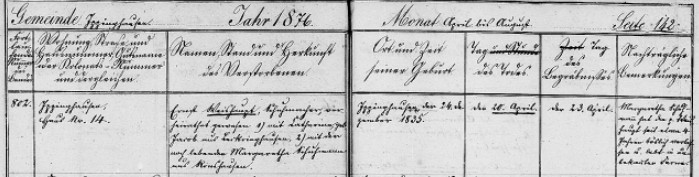
I was researching my 3rd great‑grandaunt a couple of weeks ago and came across her husband’s burial record from 1876. There was a note in the last column that immediately caught my attention. I already knew it mentioned something about his second wife—he remarried after my 3rd great‑grandaunt, Catherine Jacob, had passed away—but this note specifically stated that Mrs. Schuermann (Ernst’s second wife) had been maliciously slandering Ernst for the last four years.
Naturally, after reading that, I wanted to know more. I started digging, but I couldn’t find anything about what happened to Mrs. Schuermann afterward. What I did find wasn’t related to Ernst Weishaupt at all, nor did it explain why his wife had been slandering him.
Let’s start with the beginning!
Ernst Weishaupt was born on 24 December 1835 in Ippinghausen, Hesse, Germany, to Johann Justus Weishaupt and his wife, Martha Elisabeth Hinne. On 20 December 1862, Ernst married Katherine Jacob in Ippinghausen. The couple had four sons: Heinrich Weishaupt, born 13 November 1863; Johann Friedrich Wilhelm Weishaupt, born 24 September 1865; Justus August Weishaupt, born 24 November 1867; and Carl Weishaupt, born 27 March 1870, who died on 3 April 1872. Katherine (Jacob) Weishaupt died on the same day her son Carl was born—27 March 1870 in Ippinghausen—leaving Ernst a widower with four young boys
Ernst Weishaupt married for a second time on 29 April 1871, taking Margaretha Schuermann as his wife just one year after the death of his first wife, Katherine. There is no indication that Ernst and Margaretha had any children together. Only five years later, on 20 April 1876, Ernst died at the age of 40. His death left his three surviving sons—Heinrich, age 13; Johann, age 11; and Justus, age 9—without either parent. Tracing what became of these boys after 1876 will be my next research project.
One detail in this record immediately stood out to me: it referred to Ernst’s son‑in‑law. But my Ernst Weishaupt only had sons—no daughters that I had ever found. That inconsistency sent me digging for a daughter, but none appeared in any records. So, I shifted my focus back to Ernst and his extended family, and I quickly discovered that Ernst’s godfather was his uncle, also named Ernst Weishaupt. That raised a new possibility: could this older Ernst Weishaupt—the uncle—be the one involved in the lawsuit in Ippinghausen? And if so, did he have a son‑in‑law named Karl Emde? And just like that, I was down another genealogy rabbit hole.
I wanted to learn more about Ernst Weishaupt’s father, Johann Justus Weishaupt, and his siblings. Johann Justus was born on 25 April 1805 in Ippinghausen, the son of Johann Heinrich Weishaupt and his wife, Frederika Frese. Johann Justus’s younger brother, Johann Martin Ernst Weishaupt, was born three years later on 15 November 1808, also in Ippinghausen.
Johann Martin Ernst Weishaupt married Anna Katherine Klapp on 5 February 1838 in Ippinghausen. Anna Katherine was born on 14 September 1815, also in Ippinghausen. Together they had four daughters: Susanna Weishaupt, born 29 April 1838; Maria Sophia Weishaupt, born 29 December 1845; another daughter also named Maria Sophia Weishaupt, born 29 December 1845; and Elisa Weishaupt, born 7 August 1847—all born in Ippinghausen. The couple also experienced the loss of two stillborn children, one in 1841 and another in 1849. Tragically, Anna Katherine died just a few days after the birth of their last stillborn child, passing away on 13 July 1849 in Ippinghausen.
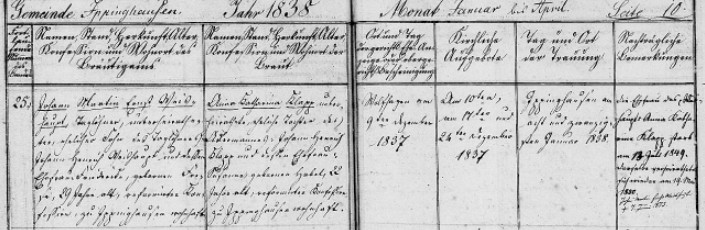
I wanted to know whether any of these four daughters might have married a Karl Emde, so I began with the eldest, Susanna. Susanna Weishaupt married Jacob Lots on 22 August 1863 in Ippinghausen. Jacob was born on 25 April 1821 in Ippinghausen, the son of Justus Lots and his wife, Christina Elisabeth Schacht. Susanna (Weishaupt) Lots later died on 15 September 1885 in Ippinghausen.

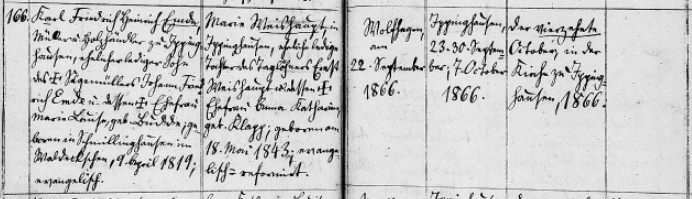
Maria was the next daughter I looked into. On 22 September 1866, she married none other than Karl Friedrich Heinrich Emde. Karl was born on 9 April 1819, the son of Johann Friedrich Emde and his wife, Maria Louisa Budda. In the years following their marriage, I did not find any records of children born to Maria and Karl.
Now it was time to look more closely at the court cases I had found—one involving Ernst Weishaupt himself, and another involving his son‑in‑law, Karl Emde.
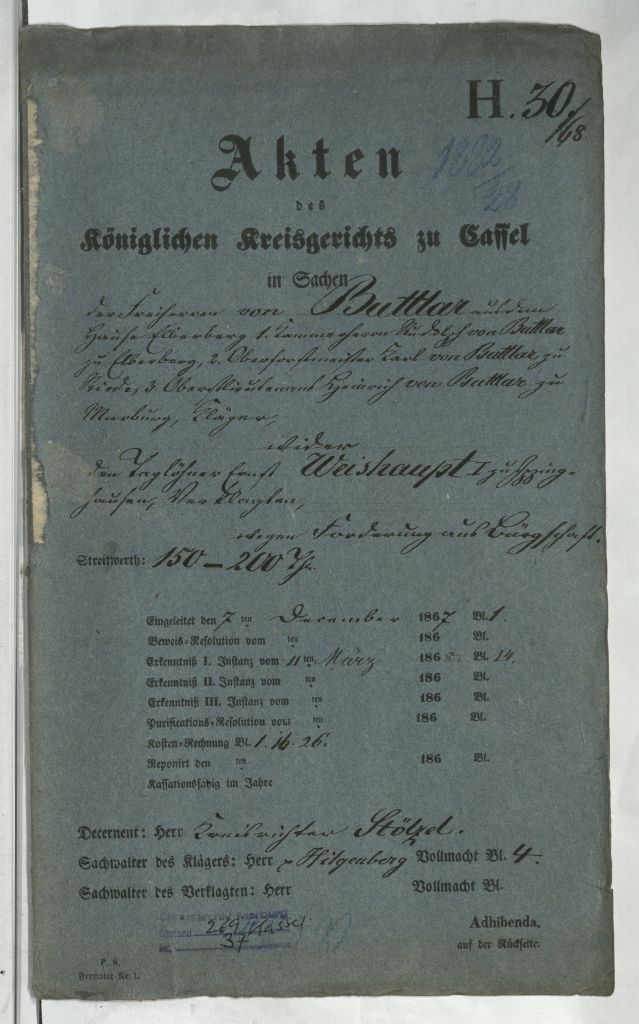
Just two years after Karl Emde married Maria, her father‑in‑law, Ernst Weishaupt, found himself being sued for a debt of roughly 150–200 thalers (which, based on my research, would be about $4,000 today). The court record states that on 3 April 1866—before Karl was technically his son‑in‑law—Ernst guaranteed a sum of 249 thalers for a delivery of wood that had not been paid for. Because he had signed for the delivery, he was now being held liable for the amount, plus interest.
On 23 January 1868, Ernst appeared in court and responded to the claim. He did not dispute that his current son‑in‑law, Karl Emde, had purchased the wood and owed the plaintiffs. Ernst also acknowledged that he had signed for the delivery, but argued that his signature had been obtained fraudulently because the contract had not been read aloud to him. On that basis, he asked that the lawsuit be dismissed.
The court did not accept his argument. On 11 March 1868, it ruled that Ernst was obligated to pay the plaintiff 158 thalers plus 5% interest dating back to 27 December 1867.
When Ernst failed to pay, the court sent a magistrate to his home on 22 June 1868 to collect the amount owed or seize property that could be sold to satisfy the debt. The magistrate reported:
“The debtor made no payment, which is why I wanted to proceed with seizure. However, only the following items were found at the debtor’s residence: A simple bed, A few pieces of furniture. In my professional opinion, the debtor cannot do without these items. He earns his living through daily wages and has a daughter to support. He owns no real estate, and as far as I have been informed, the following debts are encumbered upon him.”
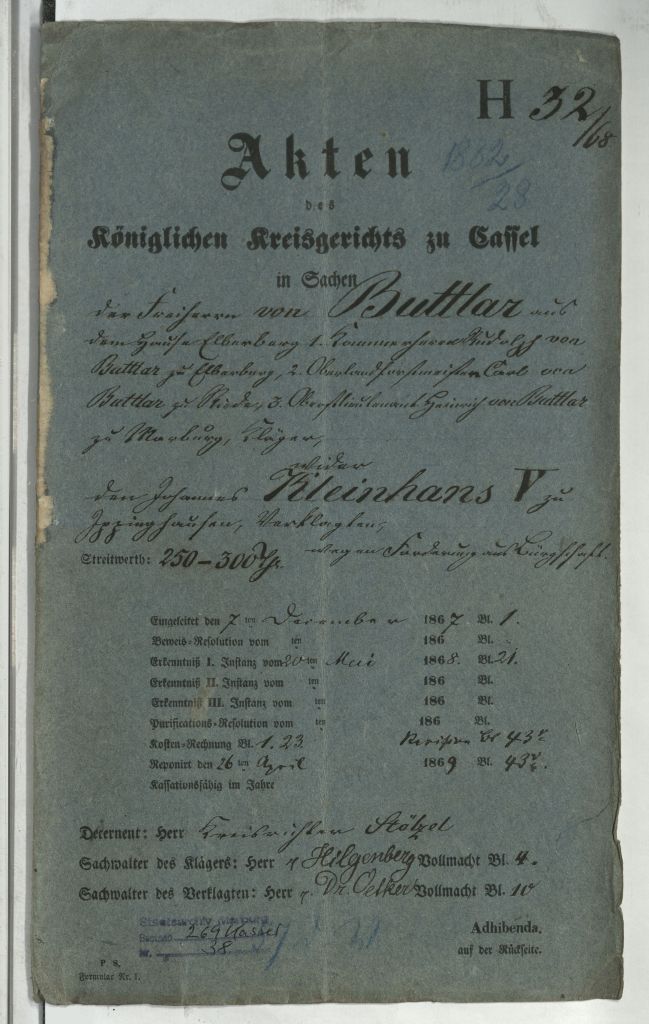
The next court filing concerned the case against Karl Emde himself. Karl objected to the claim on the grounds that the debt had already been addressed in a previous lawsuit, in which a final judgment had been issued and a lien placed on the principal debtor’s real property. The court, however, ruled that the plaintiff’s declaration—limiting his interest claim to the date of filing—should stand. Karl was ordered to pay the plaintiff 257 thalers plus 5% interest within eight days and was also held responsible for the court costs. By 29 July 1868, Karl had still not complied with the court’s order, prompting the court to request that a lien be placed on his property.
I’m not convinced that either Ernst or Karl ever paid for the wood delivery, and it makes me wonder whether the two of them may have acted together—intentionally or simply through poor judgment. Ernst died in 1876 at just 40 years old, long before any of these financial issues could have been revisited. I haven’t yet researched what became of Karl and his wife Maria after this court case and did not learn what happened to Margaretha Schuermann after Ernst death or why she slandered him. Some mysteries are harder to solve.

 Ella Jane Anne